
Two pathways to make your content pay, but which is the right fit for yours?

This post was first published on my Medium blog—follow me there for the most up-to-date entries!
Prospective clients often tell me they want to “commercialize” their training. I’m listening, but I’m also keenly aware that people often confuse monetization vs commercialization of training. The distinction matters more than they think. I see this often in medical device education, but the same mistake shows up elsewhere too.
Perhaps they have a webinar, a slide deck, a teaching demo, or a useful training. Then someone asks the obvious question: could we charge for this? Sometimes the answer is yes. I’ve done that myself. There’s nothing wrong with earning money from something useful. But charging for it doesn’t mean you’ve commercialized it. It may simply mean you’ve monetized it.
The simplest distinction
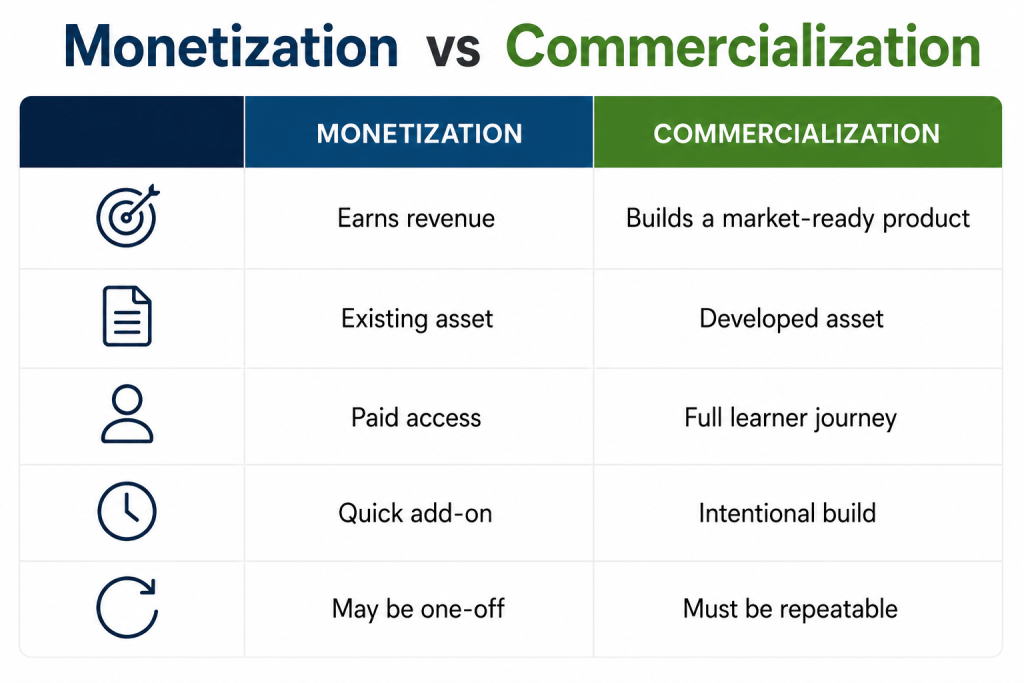
Monetization is the lighter lift. You already have something of value, and you find a way to earn money from it. Commercialization is a bigger move. It means taking that original asset and deliberately developing it into a stronger, market-ready offering.
You’re not just charging for access. You’re building something people can buy, use, and move through with confidence. It means the offering can withstand learner expectations, operational demands, pricing pressure, and repeated delivery without exposing obvious cracks.
Where teams get it wrong
If you already offer the training and then decide to charge for it, you may be monetizing, not commercializing. What does this look like? Maybe continuing education (CE) recognition is the main selling point. Maybe the main upgrade is prettier slides or a cool handout. Maybe the offer is still basically the same thing, only now it has a price tag.
On the other hand, if you’re building a true offering around the original asset, you’re much closer to commercialization. The learner experience is designed from start to finish. You’re adding multiple forms of value, not just one extra. The offer includes structure, support, application, and follow-through. You’ve thought through the operational side, not just the educational content side. And you’re preparing the offering to perform well more than once to your existing or expanded audience.
At this point, ask yourself: Are we building a real product, or just putting a price tag on an existing asset?
Why IP belongs with commercialization
In many ways, intellectual property (IP) is where monetization vs commercialization of training becomes easiest to recognize.
This is one of the most important distinctions in the whole discussion.
Monetization puts a price on access. Commercialization turns expertise into a product. And in this context, a product is something more complete than content. It has structure, delivery, support, and a user experience — not just expertise sitting in a pile.
That’s why IP belongs more naturally in the commercialization conversation. Your IP may start as a webinar, a 10–15 minute free video online, a slide deck, a framework, an expert talk, or a teaching demo. That original asset can absolutely be monetized.
But commercialization is the bigger move. It takes that original asset and develops it into something more complete and effective. I think of the added pieces as performance supports: learning supports, application supports, troubleshooting supports, and reinforcement supports. Examples may include a workbook, a toolkit, a written guide, structured follow-up, or stronger learner support. Not every offer needs every performance support, but they all need some.
Though the exact performance supports will vary, the standard does not. A truly commercialized offer still needs a coherent learning experience, strong delivery, reliable operations, clear customer support, and an experience that holds together from beginning to end.
That means thinking beyond content. Customers should not be stranded by registration, certificate, or support problems. Learners should not leave knowing more but doing no better.
If you want to use your IP seriously, monetization alone doesn’t cut it.
Common examples make this easy to see
Imagine a crafter posts a 10–minute free online video showing basic steps for how to knit a hat. Later, the creator thinks, “Oh, I could make a little money from this.” So she adds affiliate links for the yarn and needles, plus Patreon, or a “buy me a coffee” link. Eventually, she gets ad revenue.
That’s monetization. The free video still exists. Now it simply earns some revenue.
But now imagine the crafter does something bigger. She uses that same free video as the starting point for a fuller paid offer: she designs a pattern with written instructions and clear photos, a tutorial, technique tips, troubleshooting help, a cheat sheet of 10 Best Hacks for Knitting Hats (notice how clearly that supports a broader learning goal), office hours for people who get stuck, and perhaps a small support community.
That’s much closer to commercialization. The original video wasn’t discarded. It became the cornerstone of a stronger offering. I’m not criticizing the free video or the monetization. I’m saying that commercialization means adding value around the original asset — but it must be a seamless whole, not a helter-skelter top-off of material that’s an afterthought to fatten the offer. If you want fast cash, monetization may be enough. If you want to pack a punch, commercialization is the bigger move.
Here’s another simple example: A gardener can sell extra tomato seedlings to neighbors. That’s monetization. Or that same gardener can create starter kits, planting guides, labels, follow-up emails, and a seasonal buying system. That’s commercialization.
The first sale may be simple. The fuller product ecosystem is something else entirely. I work mostly in the medical device space, but this distinction applies far beyond that. Any time someone wants to turn expertise into revenue, the same logic applies. Healthcare, non-healthcare, professional education, creative work, and consulting all run into the same question. Are you simply earning from something that already exists, or are you developing it into a stronger offering with a more robust intended outcome?
Monetization vs commercialization of training: Common mistakes
When teams say they want commercialization, these are some of the most common mistakes I see:
- Treating certification like a simple add-on
- Assuming CE recognition alone makes the offer market-ready
- Having no plan for customer support
- Charging premium prices for something thin
- Confusing paid access with a real product
- Using IP without fully developing it
Those mistakes matter because they expose what the team is really doing. They may be using the language of commercialization while still thinking in terms of monetization.
Certification changes the stakes
If you’re offering certification to recognize clinical competence, do not kid yourself that simple monetization is enough. That is squarely in commercialization territory, and it calls for a defensible, scalable, fully supported offering.
Why? Because certification makes a bigger promise. It suggests standards, structure, credible assessment, and a level of support that can stand up under scrutiny. It isn’t casual. It isn’t a thin add-on. And it’s definitely not something I’d place in the same category as “let’s charge a few dollars for access.”
Monetization does not cut it when the promise is competence.
Why this matters so much in CE
For decades, my business has been recognized by multiple organizations as a provider of continuing education. So yes, I believe in CE. And I don’t believe the CE credit itself should be the main thing being sold.
CE should support transformation. It should help professionals do better, not just know more. At its best, CE offers a triple win: better clinician performance, better patient outcomes, and stronger business results. That is very different from saying, “Clinicians need credits, so let’s charge for them.”
If the credit is doing all the heavy lifting, the learning may not be doing enough work.
Commercialization is not one extra thing
A workbook alone doesn’t equal commercialization. A tutorial alone doesn’t equal commercialization. A certificate alone doesn’t equal commercialization. Commercialization is not one add-on. It is a stronger whole.
This is where monetization vs commercialization of training stops being theoretical and becomes painfully obvious.
It usually involves multiple value-added elements working together: better structure, useful tools, application support, clearer guidance, smoother logistics, stronger follow-through, and operational readiness.
And yes, operational readiness matters. I once had a client seem surprised when I asked, “What are you going to do when the customer says the registration page isn’t working?” Or, “What are you going to do when the customer says they can’t download their certificate?” Those are not side issues. They are part of the offering.
If you want premium pricing, you need to provide a premium experience. That means more than content. It means more than slides. It means more than CE.
The real question
Premium value is the heart of monetization vs commercialization of training. Monetization captures existing value. Commercialization builds additional value around the original asset. One asks, “Can we earn from this?” The other asks, “How can we develop this into something strong enough to deserve payment?”
Use the image below to compare your purpose, starting point, focus, effort, and strength. Those five factors can help you see whether you’re simply monetizing an existing asset or truly commercializing it into a stronger, repeatable, market-ready product.
This comparison is intentionally high-level. Commercialization is not about adding more content or making the offer longer. More modules do not equal commercialization. If the added pieces do not clearly support the intended competencies, you may simply be monetizing a larger pile of content. If learners come away knowing more but not doing better, the offer is larger, but not stronger. Real commercialization closes the loop: the training is intentionally designed, delivered as a coherent experience, and strong enough to stand up to both verification and validation.
So here’s my question for you: have you seen organizations say they were commercializing training when they were really just monetizing it? Have you bought paid training where the credit seemed to matter more than the learning? And what do you think a paid training needs before it deserves premium pricing?
If this struck a nerve, leave a comment below or give it a clap.
This post was first published on my Medium blog—follow me there for the most up-to-date entries!