With so many brands and materials available, your guide to choosing the perfect pair of knitting needles
This post was first published on my Medium blog—follow me there for the most up-to-date entries!
If you’re here for my usual posts on education or professional development, this post may not be for you. Feel free to skip it and come back next week. But if you knit — or if you’ve ever wondered about the best knitting needles — this post may help.
Sometimes, while I’m standing in a craft shop, another customer asks me what needles to buy, hoping there is a single perfect brand or material that works for everything. After more than sixty-five years of knitting — and after recently sorting scores of inherited needles — I’ve come to a practical conclusion.
What’s best depends on three things: the yarn you’re using, the project you’re knitting, and the way you knit.
Once you understand those three factors, choosing what will work best for you becomes much easier.
I assume you’re reading this because you’re trying to buy new needles. But trust me, the decision-making process is the same whether you’re buying new needles or rummaging through old ones.
Before explaining those three factors, though, a little context about how I ended up sorting through hundreds of knitting needles.
When your needle collection suddenly triples
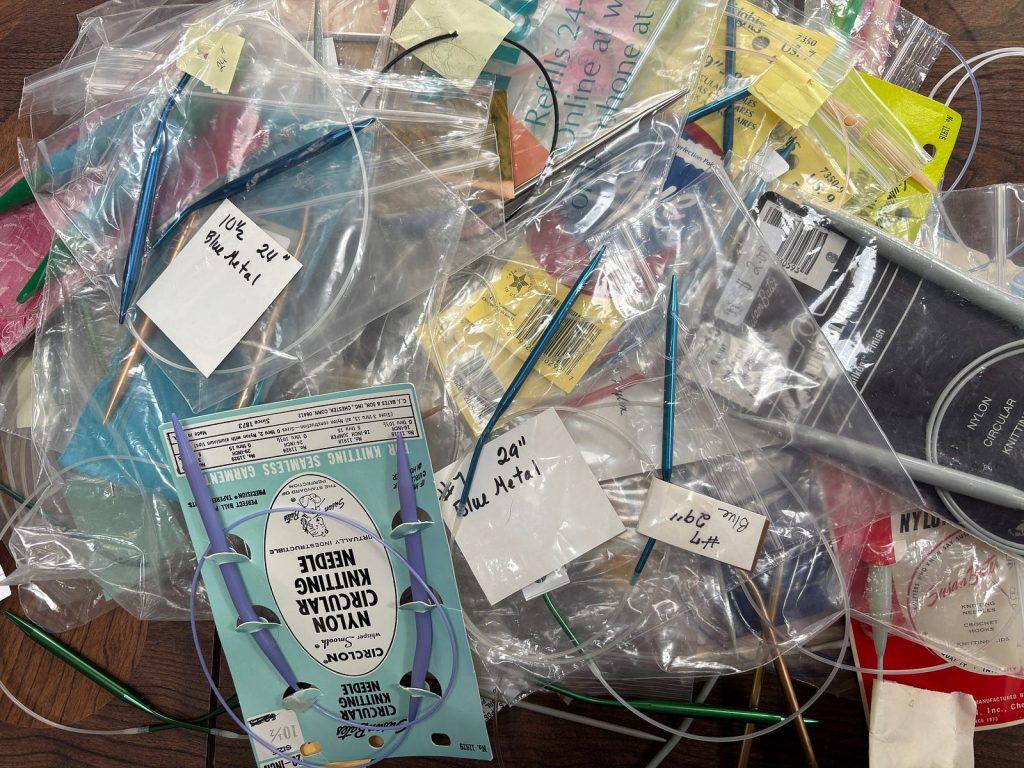
I recently inherited a knitting stash from a longtime knitter. Before this happened, I already owned more than 50 needles of my own accumulated over decades of knitting. When the inherited needles joined the collection, I had knitting needles in seemingly every imaginable size, length, type, brand, and material. Lots of needles.
I knew it was coming. The year before she died, I cleaned out my hoarder relative’s house, focusing on sorting through a lifetime of possessions to find items that would benefit her at the time. I had seen the knitting needles and assumed they would someday be willed to me, but I didn’t realize how vast the collection was.
Decades before all this my husband used to joke that I could start Marie’s Knitting Emporium. So imagine what I have now! I knew I needed to do some serious sorting.
Sorting through scores of old needles forced me to think more carefully about which needles I actually reach for — and why. While the task began as an organizing project, the conclusions about how to choose the best knitting needles apply whether you’re sorting old ones or deciding on new ones to buy.
My sorting system: love, tolerate, or donate
When you’re staring at perhaps 200 pairs of recently inherited knitting needles — not to mention the ones you already own — complicated evaluation systems aren’t very helpful.
So I kept the decision simple.
- needles I love
- needles I tolerate
- needles I donate
This simple system clarified something important. There is no single perfect brand or material that works for everything. “Best” is defined by how well they help you knit comfortably and efficiently.
In other words, the needles I loved — or tolerated or donated — usually depended on three things: the yarn I was using, the project I was knitting, and the way I knit.
Let’s look at those three factors.
How the project affects the best knitting needles
Over decades of knitting, I’ve noticed that knitters tend to fall into one of two general camps on “best” for their project. Some knitters prioritize speed. Others prioritize control.
Speed knitters often prefer smooth metal needles. When the needle surface is polished and well-engineered, yarn glides easily and knitting moves quickly.
Control knitters tend to prefer bamboo or wood needles. The slightly grippy surface slows the yarn just enough to keep stitches stable and reduce the chance of accidental slips.
Personally, the amount of speed or control I want depends on the knitting project.
When I’m working with small needles or intricate stitches, I prefer bamboo needles such as the popular Clover Takumi because they provide a little extra control.
When I’m knitting long stretches of simple stitches, including Brioche, I want speed. I’m happy to use smooth metal circular needles like the popular Addi Turbos or ChiaoGoo needles.
Wooden needles can be bamboo, birch (often laminated), rosewood, ebony, olive wood, maple, walnut or perhaps other woods. But at least here in the US, the most popular wood needles are bamboo.
Metal needles come in many varieties too, but more important than material is quality. One thing that became very clear while sorting the inherited stash is that the word “metal” can mean very different things.
High-quality metal needles are wonderful tools. The engineering behind brands like Addi and ChiaoGoo produces needles that are extremely smooth and comfortable to use. Cheap metal needles are a completely different matter. Rough surfaces split yarn, poorly finished tips snag stitches, and bad joins make knitting frustrating. Ugh. Those needles quickly moved into my donate pile. So it’s important to distinguish between well-engineered metal needles and inexpensive metal ones.
There are also plastic needles, nylon needles, casein needles, and probably more that I’m not even aware of. The plastic ones immediately went into my donation pile. The nylon ones are something I’ll tolerate if I don’t have anything better. I love the casein ones, but they break easily.
Yarn also influences what is the best knitting needle
Another reason there is no single answer to the question of what’s best is that yarn behaves differently depending on the fiber.
Sticky wool yarn often works beautifully on smooth metal needles because the extra glide keeps the knitting rhythm consistent.
Very slippery yarns — silk blends, for example — can slide too easily on metal needles. Bamboo needles provide a little friction that keeps stitches from escaping.
This is why experienced knitters usually keep both metal and wood needles.
Knitting style matters too
The way you knit also influences needles you’ll like best.
I knit both English style (sometimes called American style) and Continental style. In English knitting the yarn is held in the right hand and wrapped around the needle. In Continental knitting the yarn is held in the left hand and the needle picks the yarn.
Continental knitting can be very efficient for simple stitch patterns, and when I knit that way I often prefer smooth metal needles.
But when precision matters — small needles, intricate stitches, or delicate yarn — I slow down and switch to bamboo.
Brands I reach for most often
First, a quick note: I have no affiliation with any of these companies. I’m simply a long-time knitter sharing personal experience with tools I’ve used over many years. These are the ones I’d buy again.
For smooth metal circular needles, I often reach for Addi or ChiaoGoo because they are well engineered and extremely smooth.
For bamboo needles, Clover Takumi remains my easy-to-find dependable favorite. If I can find them and afford them, I’d choose Skacel.
Other brands fall into what I would call the perfectly acceptable category — I tolerate them. Knit Picks needles work well and are reasonably priced. I own them and use them, but they are not my first choice.
Older standbys like Susan Bates are also useful to keep around as backups or needles I might bring along with me while traveling. If I lose them, oh well. The nylon ones are very acceptable, and cheap to replace if lost.
My final answer to the best knitting needles question
After more than sixty-five years of knitting and the recent experience of sorting through the dozens of circular knitting needles I’ve found — not to mention the straight and double-pointed needles (DPNs) that I haven’t tackled or found yet — my conclusion is straightforward.
There is no single brand or material that universally represents the best knitting needles.
The best knitting needles are the ones that best support the yarn you’re using, the project you’re knitting, and the way you knit.
Sometimes that means smooth metal needles that allow stitches to glide quickly. Other times it means bamboo needles that provide a little extra control.
And if you ever inherit enough knitting supplies to make your spouse or your friends joke about opening your own Knitting Emporium, you’ll have plenty of opportunities to decide for yourself what the best knitting needles really are.
This post was first published on my Medium blog—follow me there for the most up-to-date entries!