
Learn to tell a well-structured course from an inaccessible heap of information, and how to make sure your course measures up

I’ve taken “courses” for decades. In-person, online, hybrid, self-paced, instructor-led — you name it. Maybe you have, too. But once you know how to tell if a course is a content dump, you start to see the pattern everywhere. Most so-called “courses” were never courses at all. They were content dumps that left learners overwhelmed, confused, or entertained but not transformed. And the more I learned, the more I understood why so many learners couldn’t apply what they were supposed to have learned, even when they seemed to enjoy the experience on the surface.
Most instructors focus on content volume, slide count, or clever visuals. But after decades of building, reviewing, defending, revising, and rescuing courses, I can say this with absolute clarity: Enjoyment is not the same as learning. Volume is not the same as design. Exposure is not the same as mastery.
What is a content dump?
Maybe this is your first exposure to the term “content dump.” A content dump walks like a course and quacks like a course, but it isn’t a course really. It’s just a lot of information with no direction and no way for learners to access or apply it. Often an expert’s first attempt at course design is a content dump, which makes sense: if you’re an expert in your field, you’re focused on the information itself, not how your learners are going to best absorb and apply it.
People confuse “I have a lot to say” with “I can teach effectively.” A course is not defined by how much material appears in the slides or what “topic” is covered. A course is defined by whether the content hangs together, whether there is structure and intention, whether the sequence makes sense, whether learners can follow the path, whether they can perform the outcome, and whether the experience was deliberately designed.
How to tell if your course is a content dump
I have seen hundreds of these “courses,” and they nearly always share the same unmistakable signals.
- No through-line. Ideas float without any clear direction.
- Topic hopping. “Now let’s talk about hyponatremia. Next, a personal story. Then, a statistic.” Learners find themselves wondering… what’s the point here?
- Facts without context. Interesting, yes. Useful, no.
- No measurable objectives or low-level objectives. Vague verbs like “understand” or “be familiar with” do not, by any established standard, qualify as an “objective”. Or the trio that shows up in almost everyone’s course: identify, describe, discuss. Very low-level objectives.
- No alignment. Objectives do not match content. Content does not match activities. Activities do not match evaluation.
- Decorative images. Clip art, stock photos, or a chart that looks important but teaches nothing. Ruth Colvin Clark warned us in Graphics for Learning that visuals must support learning. Most visuals in content dumps simply take up space.
- “Activities” that are not activities. True/false items pretending to be practice. Particularly with knowledge checks.
- No scaffolding. Learners are left alone to sort through complexity.
- Satisfaction surveys used as evidence of learning. “I loved the presenter!” (These can earn the 5-star reviews.) Lovely. But did they learn anything?
Here is the hardest part. When learners cannot remember or apply material a week later, they blame themselves. They believe they failed. They didn’t. The design failed.
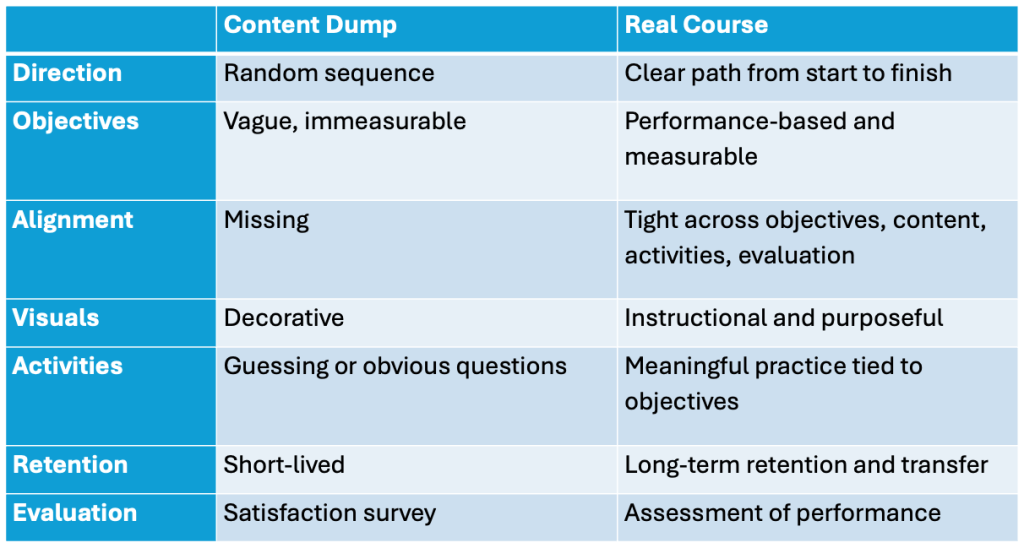
Content dump vs real course
A real course has shape, intention, and integrity. It is grounded in adult learning principles. It does not rely on charisma or attractive visuals. It relies on design.
A real course:
- begins with the learning gap
- aligns objectives with real-world performance
- structures content so each idea builds on the next
- uses visuals, examples, and stories to reinforce learning
- offers meaningful practice
- evaluates learning, not feelings
- connects the dots from the beginning to the end
When I design or review a course, I always ask one question: Does this experience help someone do something, or do something differently? If the answer is no, the course is moving toward a content dump.
The 3D test: A quick way to tell if your course is a content dump
1. Designed
A well-designed course begins with these eight elements:
- target audience
- learning gap
- overall goal
- learning objectives
- methods or approach
- content structure
- resources
- evaluation
If even one element is unclear or misaligned, the course begins to slide toward a content dump.
2. Directed
A course must take the learner somewhere. Not in circles. Not into side paths that lead nowhere. It must be intentional.
Directed courses use purposeful sequencing, logical transitions, effective pacing, and clear signposting. Without direction, learners experience what feels like instructional whiplash. Random story. Random fact. New fact. A chart that appears out of nowhere. A quote with no connection. A real-life tip that floats in isolation.
When the structural spine is missing, the course collapses into a content dump.
3. Doable
Learning is about performance, not exposure. Doable means:
- objectives reflect real actions
- practice mirrors real tasks
- application appears throughout
- evaluation measures what matters
- learners leave knowing what they will do differently
If learners finish by saying, “That was interesting, but I don’t know what to do,” you built a content dump. If they say, “Next time, I will…,” you built a course.
Self-audit: How to tell if your course is a content dump
Alignment
- Are the objectives measurable?
- Are the post-test questions (if they are even present) based on the objectives?
- Does each objective map to content and activities?
Design integrity
- Are visuals instructional rather than decorative?
- Is cognitive load manageable?
- Does the course scaffold from simple to complex?
Learner fit
- Is the content pitched correctly for novice, intermediate, or expert learners?
- Does the course meet the learning gap?
Learning impact
- Will learners remember the content tomorrow?
- Can they apply it next week?
- Does the course feel coherent? Does it flow?
- Are transitions meaningful?
- Is anything included simply because you liked it? (This is a question you want to answer “no” to.)
A well-designed course passes most of these checks. A content dump fails early and often.
If you want help knowing if your course is a content dump
If you’re not sure whether you created a real course or a content dump, or if you are staring at your slides thinking there must be a better way, you do not need to figure it out alone.
I can audit what you already have, identify the gaps, and help you transform scattered material into a cohesive, well-aligned learning experience. Send me a DM on LinkedIn.
Your learners deserve more than information. They deserve learning. They deserve to actually change their on-the-job-behavior as a result of the course. If you’re ready for that, I can help you understand how to tell if your course is a content dump and what to do differently the next time.