
A practical (and surprisingly emotional) guide to understanding the purpose behind your travel

What’s the difference between a trip, a visit, and a vacation? You might toss them around as if they’re interchangeable, but these three words describe three completely different emotional experiences. They reveal why we’re traveling, how we expect to feel while we’re away, and what we hope to get out of the time we spend away from home. And once I made the distinction, it totally changed the way I think about travel.
So here it is, the clear comparison I wish I’d recognized earlier: What makes a trip, what makes a vacation, what makes a visit, and why the difference matters.
What is a trip?
A trip is travel defined by purpose — often necessary, often urgent, often structured around someone else’s timetable or a set of unavoidable tasks. You go because something needs to get done. The experience may have bright spots, but those are incidental. The purpose drives the travel, not pleasure.
One of the clearest examples in my own life is the time I had to clean out a hoarder’s house in another city. Everything about it was a trip:
- It was out of town.
- It was exhausting.
- It was emotional.
- It was unavoidable.
And yet there was a surprising sweetness woven into the chaos. Three of my college friends showed up to help. They brought food for us to share each night. A few neighbors joined in, and together we created small pockets of warmth in the middle of a very difficult job. There was satisfaction, connection, and even humor.
But still, the goal was the goal. It was a trip, not a vacation. A trip can be meaningful. It can be productive. It can even be gratifying. But it is rarely restorative.
A trip ends with completion, not renewal.
What is a visit?
A visit is travel shaped entirely by relationships — their warmth, their joy, their messiness, their history. It isn’t defined by rest, and it isn’t defined by accomplishing a task. It is defined by temporarily stepping into someone else’s world. It’s about connection.
A visit can be cozy, chaotic, sacred, stressful, hilarious, heartbreaking — or some swirling combination of all those things. It might mean:
- sleeping in a guest bed that kills your back
- sidestepping political minefields at the dinner table
- revisiting old family dynamics you never asked to revive
- feeding an elderly relative who can no longer lift a spoon
- keeping vigil through someone’s final hours
And sometimes, it means you go simply because your family expects you to show up — even when you dread it. That reluctance is often the loudest clue of all: you’re not the center of this trip, so it’s a visit.
But visits can also hold moments of deep beauty:
- passing around faded photos or 35 mm slides
- watching ancient family reel-to-reel films
- laughing so hard your sides hurt over family stories no outsider would ever understand
- eating pie made from your grandmother’s recipe
A visit can be holiday cheer or funeral grief, a reunion or a reckoning.
A visit doesn’t necessarily center one other person in particular, but it definitely doesn’t center you. You’re participating. You’re contributing. You’re remembering. You’re supporting. But you’re not restoring.
Visits matter — profoundly.
But they are not vacations.
What is a vacation?
A vacation is defined by a single element: restoration.
It doesn’t hinge on distance, duration, budget, or whether a plane is involved. A vacation is what happens when you temporarily step out of your roles and responsibilities and move into a space where your well-being is the center of the experience. This is a core difference in the difference between a trip, a visit, and a vacation.
A vacation is:
- chosen
- restorative
- freeing
- pleasurable
- centered on your needs, not anyone else’s
And it doesn’t have to last two weeks or involve a passport.
One of my recent experiences was a perfect example: we drove only about 100 miles to see the band Chicago. A simple Friday-through-Sunday getaway — and everything about it was restorative.
- a fabulous meal inside the fully restored 1854 historic Herdic House (Herdic Mansion): (All food was sourced at local farms!)
- a wander through the World of Little League Museum
- a stop at the stunning St. Joseph the Worker Church, an 1889 architectural gem, boasting a marble altar, bell tower and extraordinary pipe organ
It felt light. It felt freeing. It felt like oxygen.
That weekend was a vacation, even though it was close to home and short. It reminded me what joy and restoration feel like — and why my husband and I need more of them. A vacation doesn’t need to be complicated. It needs to be restorative. That’s the heart of the whole distinction between a trip, a vacation, and a visit.
A vacation is a deliberate shift from obligation to renewal.
It gives you back to yourself.
The difference between a trip, a visit, and a vacation: the clean comparison
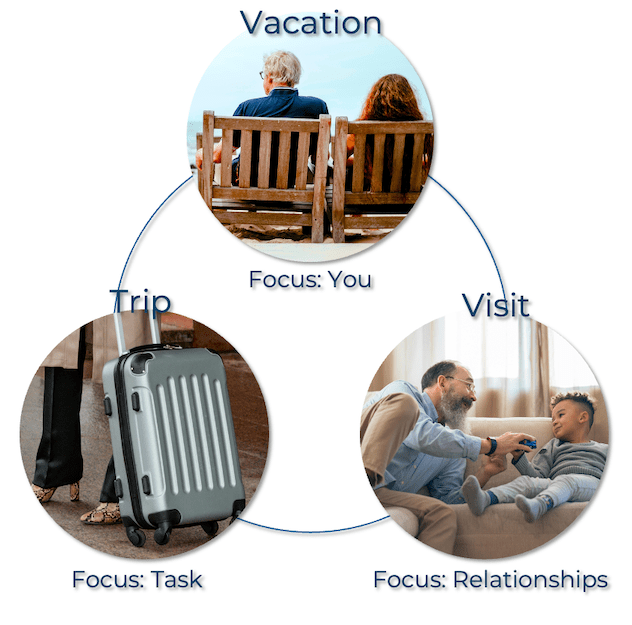
Who is the travel centered on?
- Trip: the task
- Visit: relationships
- Vacation: you
What’s the emotional outcome?
- Trip: relief or accomplishment
- Visit: connection, nostalgia, or emotional fatigue
- Vacation: renewal and energy
What drives the structure?
- Trip: necessity
- Visit: interpersonal dynamics
- Vacation: autonomy
Can all of them include joy? Yes. But joy doesn’t determine the category — purpose does.
Why the distinction matters
Realizing the difference between a trip, a visit, and a vacation has opened a new door in my life. For decades, nearly every out-of-town experience I had fell into the “trip” category: necessary, goal-oriented, often exhausting. Sometimes I squeezed in a visit or tacked on a short vacation afterwards. But a real vacation? A true break? Something chosen purely for my own restoration?
Selling my primary business changed that. (I now do only consulting.) For the first time in decades, I can take a real, extended, deeply restorative vacation. Not a trip, not a visit, but the kind of experience that provides space to breathe differently and live differently for a while.
Naming things clearly helps protect them. A visit is meaningful. A trip is necessary. But a vacation?
A vacation is all yours. And after all these years, I’m ready for mine.