
What’s better than a workbook? How about a series of workbooks that evolve with your learners?

This post was first published on my Medium blog—follow me there for the most up-to-date entries!
If your training course only has one level, you’re missing an opportunity. A tiered course allows for greater growth in your learners, not to mention a stronger business. Think of your tiers as a “good-better-best” model, with the lowest being free and the highest being a big-ticket, multi-day course. Each tier calls for its own rhythm, its own kind of engagement, and its own weight. That’s the heart of tiered workbook design — building depth and sophistication that rise with the learner.
I started designing courses in the 1980s, long before “online learning” was even a thing. Back then, if I created a workbook, I had no idea how to figure out what to create for any course, much less a course that could scale. Four hours? Eight? Sixteen? Didn’t matter. (And, honestly, in those days, what I might have called a workbook wasn’t. It was a pile of papers.)
Experience has taught me that one-size-fits-all doesn’t work in education. The workbook that supports a quick, self-paced course will fall flat in a live, credential-bearing one.
Tier 1: The foundation workbook
If your Tier 1 course is a four-hour, self-paced foundational course, the workbook shouldn’t overwhelm the learner. It needs to guide, reinforce, and motivate.
I like to think of the Tier 1 workbook as the learning companion. It follows learners through the modules (each one being a self-contained topic or lesson), keeping them anchored while they move through new content.
Purpose
At this level, the purpose of the workbook is retention. It helps learners remember, not master. It’s the on-ramp, not the highway.
Length and structure
Keep it short. I’d say 8 to 12 pages, or roughly 2–3 pages per instructional hour. Each page should earn its place by helping learners connect what they’ve heard or seen with what they already know.
What belongs inside
I doubt there is any official “formula”. But here’s what I would feel compelled to include in a workbook for the lowest tier.
- Key points and learning objectives
- Terminology and definitions
- Simple knowledge checks or fill-in exercises
- Reflective questions (“What stood out to you most?”)
- A few critical visual aids — tables, diagrams, or flowcharts
- A short section for next steps (how to claim CE credits, related resources, etc.)
You’re not trying to make the workbook fancy. You’re trying to make it useful. It should feel approachable, digestible, and doable in one or two sittings. The key word at this stage of tiered workbook design is learn.
Tier 2: The professional workbook
Now we’re at the eight-hour course; a mix of recorded modules, live Q&A, and workshop-style interaction. Here, the workbook grows up a bit. The Tier 2 workbook becomes a practice companion. It doesn’t just capture notes; it connects learning to action.
Purpose
Tier 2 workbooks reinforce and integrate learning. They help professionals see how the concept works in context, and they start introducing the element of proof — not just “I learned it,” but “I can use it.”
Length and structure
Plan for 15 to 25 pages. That’s long enough to include multiple types of activities and still feel like a single, coherent guide. Each module’s section should include three elements: a quick list of key points, an application or reflection task, and a short knowledge check that ties directly to key points that reflect real-world use.
What belongs inside
Again, there’s no real “rule” here, but these are some ideas I’d favor for a mid-level workbook.
- Case vignettes and short scenarios
- Sequencing or prioritization activities
- Troubleshooting charts (“If this happens, then try…”)
- Checklists and templates
- Prompts for discussion or small group debriefs
- Space for live session notes or workshop reflections
The workbook now bridges content and community. It’s designed for someone who’s already engaged in the material and wants to apply it — not just recall it.
The key words at this stage of tiered workbook design are practice and application.
Tier 3: The mastery workbook
By the time you offer a sixteen-hour course — complete with live workshops, small-group coaching, performance-based assessments, and perhaps a community — the workbook transforms into something very different. The Tier 3 workbook isn’t just a learning tool anymore. It’s a performance portfolio.
Purpose
Tier 3 workbooks enable transformation. They move learners from knowing to doing to demonstrating. They’re built for professionals who need documentation — evidence of competence, readiness, and results.
Length and structure
Expect 25 to 40+ pages, often including appendices or advanced templates. At this level, the workbook doubles as both a learning record and a professional reference. Each section or module may include pre-work prompts, advanced case studies, capstone templates, peer feedback rubrics, implementation guides, or job aids.
What belongs inside
- Decision-making frameworks
- Strategy grids or flow models
- Reflective tracking (“How have you applied this in practice?”)
- Portfolio artifacts for certification or coaching feedback
At this stage of tiered workbook design, the workbook becomes part of the credentialing process itself. It’s no longer supplementary. It’s central.
How the workbook evolves
Think of your workbook as evolving alongside your learner. Each tier builds on the last, shifting from guidance to application to mastery. The workbook’s purpose, tone, and structure mature with the course itself.
Tier 1: Foundations — The learning companion
At the entry level, the workbook is a steady guide. It helps learners grasp the essentials and gain confidence in what they’ve just heard or read. The tone is directive the focus is on recall, clarity, and reinforcement. Learners finish this tier saying, “I understand the essentials.”
Tier 2: Professional — The practice companion
Here, the workbook grows in both length and purpose. It shifts from instruction to engagement, prompting learners to apply new knowledge through short scenarios, reflection prompts, and checklists. The instructor’s goal is to strengthen transfer: to help learners connect theory to practice with confidence.
Tier 3: Mastery — The performance portfolio
At this level, the workbook becomes both a learning tool and a professional record, and often includes templates or appendices. It asks learners to document, evaluate, and adapt what they’ve learned in real settings. The focus is validation: helping learners prove competence and readiness, while giving instructors clear evidence of growth.
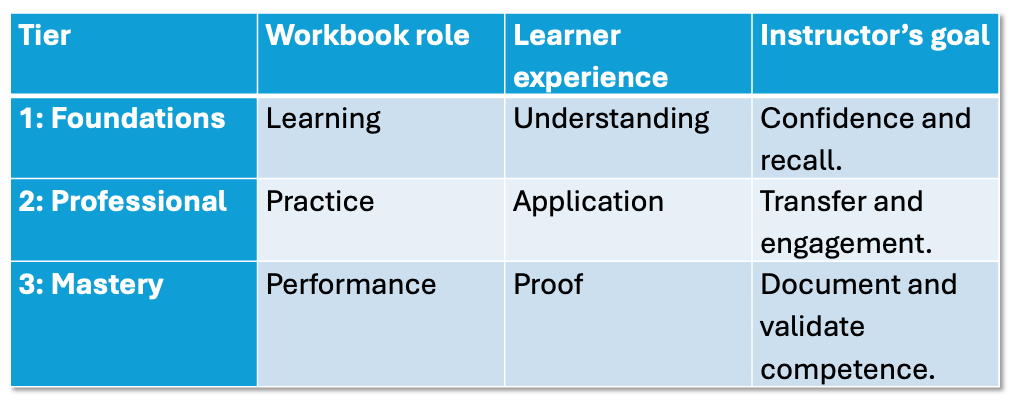
Each tier adds another layer of sophistication: more interaction, more autonomy, and more value. By the time learners reach Tier 3, the workbook isn’t just a tool they use. It’s a record of their professional growth. This is the strength of tiered workbook design.
Design elements that scale
Tone:
- Tier 1: directive (“List three key points.”)
- Tier 2: guided (“Apply this to your practice.”)
- Tier 3: empowering (“Develop your own framework.”)
Design complexity:
- Tier 1: simple boxes and lines for responses
- Tier 2: integrated exercises tied to discussions or feedback
- Tier 3: open-ended prompts for projects and reflection
Value perception:
- Tier 1: a takeaway resource
- Tier 2: a tool for implementation
- Tier 3: an asset worth keeping
The workbook doesn’t just grow. It matures. It shifts from giving answers to prompting insight, and finally to documenting expertise.
The instructor’s advantage
When your workbook scales with your course, two things happen:
- You save time. You’re not reinventing the wheel. You’re expanding the design in deliberate layers.
- You add value. A strong workbook isn’t filler; it’s proof of quality. Learners sense that instantly.
It’s what turns a $100 course into a $300 one — or a $300 course into a $1,200 certification program.
The takeaway
Every workbook has a job to do. At the foundation level, it builds confidence. At the professional level, it builds competence. At the mastery level, it builds credibility.
That’s tiered workbook design — evolving your materials as your learners evolve with you.
Next up: how to develop workbook templates you can reuse across tiers — so you scale quality and efficiency without starting from scratch every time.
If you’ve been following my recent posts, you’ve seen how a workbook differs from handouts and how knowledge checks create real engagement. This piece continues that thread — showing how your workbook can evolve as your course grows.
This post was first published on my Medium blog—follow me there for the most up-to-date entries!